Showing posts with label safety. Show all posts

RS Classic: Remembering NASA’s tragedies - Columbia Accident

>> Tuesday, February 1, 2011

Yes, I'm still shut down, but this is an important week for NASA, something we all must remember lest it happen again. Today is the anniversary of the Columbia break up during reentry and a post I wrote two years ago.

This is the hardest anniversary for me. Not that the others weren’t just as tragic, just as painful, that those lost weren’t just as brave and their deaths just as untimely. But I wasn’t even born when Apollo 1 burned so horribly. And I was just a kid in college when Challenger was torn to pieces. I wasn’t responsible.

But STS-107 was my flight. I was the EVA Safety Flight Lead for this flight. I knew the crew personally. I knew the team supporting them. I’d watched them practice in the Neutral Buoyancy Lab. I was there as the flight went through delay after delay. I went in the Mission Evaluation Room (one of the back rooms at Mission Control that supports “the Front Room”) and spoke to the folks manning the safety console every day. There were no scheduled EVAs so I wasn’t working shift. In fact, unless a contingency EVA was needed, neither was I. But I checked in physically at least once a day.

And I never saw this coming. I never heard any of the feverish concerns going on in different areas. And, sadly, I wasn’t even watching the landing. After all, nothing had gone wrong.

I was actually sleeping in, that morning of February 1, 2003. My husband of only a few months had (and this never happens) gotten up early that Saturday morning to watch cartoons. I was barely pregnant at the time - I don’t think I even knew it yet - and was feeling lazy. My daughter was at her father’s house that weekend. And Lee called out to me from the living room. “Uh, hon, I think the Shuttle just disintegrated.”

“Don’t even joke about that,” I snapped.

“I’m not joking.”

I may have mispoken when I said I never saw it coming. I had dreamed of it and it was one of those extremely rare dreams of mine that I remembered: a Shuttle coming in and breaking into fiery pieces. Whatever dreams I might have generally, I have no remembrance of them when I wake up. But this one, I remembered.

I had been worried about a potential risk. The program and my management had become comfortable with what they knew. I had not. But I had moved on to a different area and only kept track of what was going on sporadically. And I had dreamed of just such a disaster.

Of course, there is considerable evidence that the culprit that damaged the sensitive RCC panels was foam, rather than what had worried me, but that didn’t make it better. We’d been hit by foam repeatedly over the years and had talked ourselves out of worrying about it. We saw the hit before we landed, and we didn’t do more. All of this is well documented in the CAIB report . We fell into the same trap and the same causes culture-wise were cited in the CAIB report that we had heard in the Rogers Commission report from Challenger.

When Columbia reentered, the plasma began burning through the wing, first tearing off the protective RCC panel, then tearing through the structure, hydraulics and wiring, even the tire, behind it. In minutes, the Orbiter began to break up and rain debris over Texas and Louisiana.

To be honest, I’m not sure that we could have saved this crew if we had recognized the danger before they came down. I know we would have tried, would have pulled out all the stops, killed ourselves to save them if we had known what was to happen. I believe that absolutely. But, and this is the lesson we need to take forward into our future endeavors, the best way to have saved them was to keep this from happening.

We learned a great deal in the years that followed this tragedy, more about the materials we use to protect the Shuttle and the limitations and capabilities we have of bringing the Shuttle down safely if something like this ever happens again. And we know more about the risks that scared me and about the foam and ice on the ET and we have steps to address that, too.

Seven Astronauts paid for that lesson: Rick D. Husband, William C. McCool, Michael P. Anderson, Ilan Ramon, Kalpana Chawla, David M. Brown, and Laurel Clark. I must also note two others who died during recovery efforts: Jules F. Mier Jr. and Charles Krenek

Have we learned enough to preclude a recurrence? I don’t know. I hope so. I hope we tuck the lessons like Apollo, Challenger and Columbia in the corner of our minds whatever else we do and we resolved “Never again!” I don’t want us to grow complacent that such tragedies are inevitable, the price of going where no man has gone before. I want us to kick and fight and claw our way forward, unwilling to give an inch to fate, unwilling to accept defeat and any more deaths.

In the end, time will be the true judge on how well we have learned from these tragedies. Here’s hoping this is truly the last for human spaceflight. According to our previous Space Shuttle Program Manager , we still have work to do.

Read more...

RS Classic: Remembering NASA’s tragedies - Challenger Accident

>> Friday, January 28, 2011

Yes, I'm still shut down, but this is an important week for NASA, something we all must remember lest it happen again. Today is the anniversary of the Challenger accident and a post I wrote two years ago, though for some reason newspapers have been writing like it was the 27th. I have no idea why.
Apollo 1 is not as well-known as some of the other NASA tragedies and, because it happened 42 years ago, many people don’t remember or even know about it. I doubt that’s true of the events that happened on this day, January 28, 1986, 23 years ago today [25 now]. On that day that STS-51L ended 73 seconds after launch, disintegrated, taking all those on board to their deaths.


The Shuttle Challenger’s stack lifted off, but, as soon as the Solid Rocket Boosters (SRBs) ignited, smoke could be seen escaping from the stack as the heat from the flames from burning solid fuel escaped past O-rings in the joint of the SRB that had shrunk and become brittle in that cold January morning. Within only a few seconds, the O-rings had been vaporized by the escaping hot gases but an aluminum oxide layer had acted as a temporary seal. However, as the Shuttle approached Max Q (that point where they reached maximum dynamic pressure), the Shuttle also was hit with the highest wind shear seen to date in the Shuttle program, which disrupted the temporary seal. That’s when the plume first appeared.

Plume during flightThe joint’s plume impinged on the external tank within a second. Less than 4.5 seconds later, the external tank was leaking. This was happening too fast and the visual evidence had not been “noticed” except by cameras for controllers or crew to understand what was happening. Less than 8 seconds after the External Tank began leaking, the leaking SRB started pulling away from its rear strut. The pilot’s last utterance, “Uh oh.” Less than a second after the SRB first started pulling away, after the hydrogen tank blasted into the oxygen tank and the SRB slammed into the external tank structure, the Shuttle, yanked from it’s proper attitude and was torn to pieces by aerodynamic forces.

The crew cabin, though not airtight, survive the initial break up intact. There are indications that the crew survived the immediate g-loading and might have even regained consciousness during the 2.5 minute trip to the ocean surface. The impact with the ocean, however, at roughly 334 km/h (208 mph) was not survivable.

For just over a minute, we had a launch and then, nothing but bits of debris and remains.


Again, this was a preventable accident. The by-blow and and extrusion were known phenomena as were the characteristics of the O-rings (or at least uncertainty about them). Engineers with the SRB contractor, Morton Thoikol, had had concerns, but they had been dismissed by both contractor and NASA management.

Although the Rogers Commission made many recommendations about safety, management decisions, the real star, in this humble safety person’s opinion, was Richard Feynman, the physicist, who, while the commission was taking their tours and talking to managers, was wandering about unsupervised and talking to the engineers who knew what the problem was, who had spoken up and been dismissed. He wrote an appendix to the commission’s report that should be required reading for anyone working safety in any capacity, including commercial space flight (I hope you’re listening).

This kind of accident was preventable. Our assurance that something couldn’t go wrong because it hadn’t before was faulty (and, sadly, we had to learn this a second time). Seven people paid the price for that short-sightedness: Ellison S. Onizuka, Sharon Christa McAuliffe, Greg Jarvis, Judy Resnik, Michael J. Smith, Dick Scobee, and Ron McNair.

On this, we learned, but I don’t think we learned enough for many of the issues cited in the Challenger report, were repeated in the Columbia report. But then, that’s Sunday’s tale. There is an excellent video on this link . It’s 44 minutes and it’s painful to watch. I never watch it without weeping, but it is beautifully done and very informative.

Learning by attrition is not the way to learn.

Read more...

RS Classic: Remembering NASA’s tragedies - Apollo 1 Fire

>> Thursday, January 27, 2011

Yes, I'm still shut down, but this is an important week for NASA, something we all must remember lest it happen again. Today is the anniversary of the Apollo 1 fire and a post I wrote two years ago.

This is a tough week for NASA and for those that care about safety and space. In the space of six days, we have the anniversaries of each of the worst space disasters resulting in loss of life (though we have lost ground support personnel in other accidents): Apollo I, STS-51L (Challenger) and STS-107 (Columbia). It’s a sad time for us, a time to reflect on what we’ve done wrong and on the brave and talented souls that paid the ultimate price for our mistakes.

The sad thing, as I mentioned in a comment for yesterday’s blog, is that all three of these accidents were preventable. Of all the lessons we should be taking home, that is the one we must not lose sight of. There are issues and unexpected bad things that can always hinder us in space, things we can’t necessarily be fully prepared for; we must not add those risks we can correct.

But, as sad as it is to discuss these, they stand as lessons that may have helped us further down the line, that, hopefully taught us things that have saved other lives. If we have learned too late, at least we learned. But those of us who care passionately about the safety of the crew, those of us who are responsible for the lives of others, we must look back on these mistakes periodically, not only to make sure those lessons are still fresh in our minds, but also to remind ourselves why we work so hard to do the right thing. To prevent tragedies like this.

If I’m sometimes critical of our human space program, I have to say that a huge portion of what everyone does is to protect human life. These accidents remind us why that effort is worth it.

Charred crew module interior after the fire, NASA image42 years ago today, on January 27, 1967, the crew of AS-204, which they called Apollo 1, climbed into the crew module for the new Apollo missions, the first involving three crewmembers for a plugs-out test, which was not expected to be hazardous. The module was pressurized to 16 psia, higher than ambient, and was 100% oxygen, which the contractor recommended against. The crew module had a number of known but uncorrected flaws and the crew had expressed concern about fire hazards. The astronauts had also lobbied successfully for an outward opening door, but that design change was not incorporated here. Still, flawed or not, the hope was to successfully pass the test today and launch it three weeks later in February.

At 6:31:07, *before the test had even started*, the first cry of fire came from the cabin. For about 10 seconds, one could hear frantic movements followed by Chafee yelling, “We’ve got a bad fire! Let’s get out! We’re burning up! We’re on fire! Get us out of here!” Then, a scream of pain and the end of the transmission, seventeen seconds after the first report of fire. The crew module ruptured from the pressure and toxic black smoke poured from the module.

It took another eight minutes before they could open the hatch, by which time the fire had gone out. It took 7.5 hours to remove the crews remains, as they were fused in place by the melted nylon of their suits. It was not a fun way to die.

In the end, a number of key factors were called out as potential causes and contributors. The high pressure oxygen environment was very dangerous from a flammability standpoint (”in which a bar of aluminum can burn like wood” according to Wikipedia). There was a wealth of off-gassing flammable nonmetallics like nylon and velcro. Wiring and plumbing was substandard (note that 1407 wiring *design* problems were corrected after Apollo 1) with a stripped and abraded wire near a leaky coolant line (a potential exothermic explosion) but just the static electricity from their suits were found sufficient to have started a fire in that atmosphere. We were not short of smoking guns and no single cause was ever determined as *the* cause.

We were feckless, we were sloppy and we thought that the success with Mercury and Gemini at 100% oxygen made us bulletproof. Astronauts Edward H. White II, Virgil I. Grissom, and Roger B. Chaffee paid the price.

You’ll be pleased to know that nonmetallics are given careful consideration before flight, requiring both toxicity and flammability off-gassing tests (if not a previously flown material). Even the simplest ground tests are done with emergency personnel on site, with procedures for rescuing test subjects practiced and in hand (and that have saved lives since, but that’s another story), a thorough safety review before proceeding. We fly with an air mixture (except in the suits) and wiring and materials are held to very high standards. Materials used, particular “on” the crewmembers must be self-extinguishing (and materials developed for space use are also in use by firefighters all over the world).

But, as we move forward, we must remember these lessons and not get complacent. It’s been a long time since such a thing happened and, especially as we move to commercial human spaceflight, these lessons should be revisited. I hope everyone with the intention of shuttling people into space has read and understood the lessons in this one tragic not-quite-test.

May we never forget.

Read more...

RoHS and Regulating Smartly

>> Tuesday, July 6, 2010


I am all for doing the smart thing when it comes to our environment. I understand (quite well) that asbestosis and many other environmental lung disorders will be a thing of the past largely because of regulation. I know that the EPA has had a significant impact on the environment, and most of it was good. I know that California's tight air quality regulations have drastically reduced the air pollution in cities that used to be lost under smog. I've heard of creeks/rivers so polluted they could catch on fire and I'm grateful that, except off the Gulf Coast (thanks to the oil spill), that's also a rarity in this country.

And I know regulations involving lead in paint, gasoline and children's toys are a huge factor in why the lead level in this generation's children is much lower than it was in the generations that came before. But that doesn't mean that every ban is the right thing to do, even for something as dangerous as lead.

The Restriction of Hazardous Substances Directive, is a directive of the European Union intended to reduce dangerous heavy metals and two flame retardant materials in industrial wastes. Great idea, largely. There can be as much as 2 kg of lead in a cathode ray tube (which are going the way of the dinosaur) and more lead in many other components. To date, I've heard little to no complaining about those aspects of the regulation. In fact, in my technical part of the world, all I hear complaining about is lead-free solder and pure tin (i.e. lead-free) plating.

Now, before I go further on this, let me mention two things. First, I'd take this (RoHS) a lot more seriously if batteries (both those with cadmium and those with lead acid) were part of this directive - they're not. There is a battery directive that limits cadmium, but not lead, although it promotes more battery recycling. But, at this point, 90% of the lead put in products today is used in batteries. I have to say, dealing with the rest of the lead while leaving the lead battery issue largely untouched is much like closing the gate once the horse has left.

Secondly, though I have concerns about the lead-free solder, there are some uses where lead-free solder might be the right choice, for various reasons. But not always.

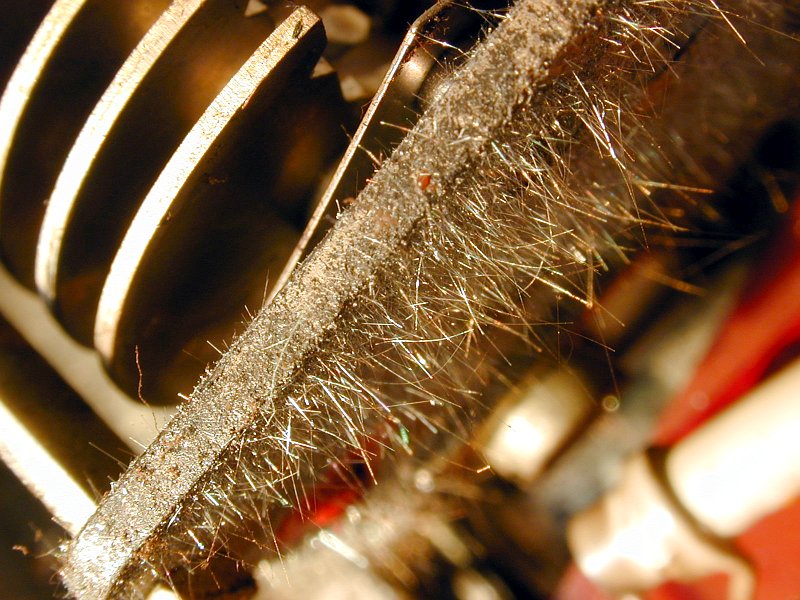
Now there's a whole list of issues with lead-free solder. but what I want to focus on here are those that result from the use of pure-tin plating: tin whiskers. Because reducing a tiny fraction of the lead in the environment (there must be natural sources of lead in the environment, too, right? That's where we get it... Sorry, distracted) is only the right thing to do if the cost for doing so (i.e the good of the consumer) isn't higher.

In this case, I don't think it is. Sure, in most cases of consumer electronics, the power source is small (like a battery, not covered by the RoHS) enough that metal vapor arcing is unlikely. Which means that, worst case, you get a short that shorts it out - and it's broken - and, best case, it's just an intermittent irritation. But some plugged in electronics have the power, and to spare, to create metal vapor arcing, which can not only destroy the electronics, but everything around it, readily causing a fire. High price for a few grams of lead. And, given the ubiquitous nature of electronics, a design that allows the arc once can allow it over and over again. A number of metal vapor arc failures happened in designs that included circuit protection I might add.

After all, RoHS just applies to consumer products. Which is great. Unless, say, your consumer product happens to be a car, which has a fairly high power electric system with more than enough power to induce metal vapor arcing. But, even if it doesn't burst on fire while you're driving, imagine what an intermittent power or data short can do to an electronically controlled car like most of us drive.

But, let's assume that consumer electronics are "perfectly safe" with minimal impact. Unfortunately, with the vast bulk of consumer electronics requiring lead-free electronics, parts with plating containing sufficient lead to preclude whiskering will become either impossible to find or prohibitively expensive for those applications where high reliability parts are essential.

Like medical equipment like apnea monitors and pacemakers, which are specifically exempt from the RoHS requirements (at this time), but that have had to be recalled because of tin whisker failures.

Or commercial satellite failures, which, while no one was hurt, were very very expensive. Or military equipment like planes and missiles. Or the Space Shuttle. The military, NASA and the FDA have specific prohibitions against pure tin plating, yet they've all been struck with tin whiskers from parts that got through the system.

Or there was this, the tripping of a nuclear reactor by the lowly tin whisker (and there are multiple other examples of nuclear scrams and pre-trips of nuclear reactors from the same cause). And there are more failures no one's willing to admit to except as an anecdote.

(For those who have become fascinated, check out the interesting stuff on silver whiskers and zinc whiskers, the latter having taken out whole highly redundant computer centers).

The lesson I want to impart here is that we need to be careful and cautious about what we do to the environment and ourselves, but we need to understand the implications of trying to make everything "perfect." Regulations (if they're smart) can do tremendous good, preventing such catastrophes as we see off in the Gulf right now (an abject lesson in lax regulation). But a regulation that does not take sufficient account of the consequences, can be just as destructive and short sighted.

We need to be smart about regulation instead of one extreme or the other.

Read more...

RS Classic: Distraction Is Deadly

>> Friday, May 28, 2010

As before, I'm reissuing a blogpost from my old Rocket Science blog. In this case, I referenced a serious concern that's particularly timely now that summer's steaming in - leaving children in cars. I know all of us parents would like to think it could never happen to us. Well, I thought that about my son getting his hands on adult medicine so it doesn't hurt to remind everyone. The "Fatal Distraction" article referenced below is still a good link and, since I first published it, it won the 2010 Pulitzer for feature article. It's long. It's heart-wrenching, but well worth the read and, in my case, reread. Bring tissues. Also, it looks like my son has come through this latest episode unscathed. Thank you for all your kind thoughts.

I wasn’t going to write on this topic today. I was innocently reading the New York Times when I stumbled upon a brief story titled “Who Forgets a Child in a Car?” which links an entirely different story in the Washington Post entitled “Fatal Distraction.” The first article advocated reading the entire post article, down to the end and she wasn’t lying. Every parent with small children should read it and I say it though it was probably the hardest thing to read I’ve ever read. Not because it was poorly written – oh no – but because it hurt so badly. Babies, left to die of heat related causes in cars, not by monsters, but by parents who loved them dearly. (I wrote several weeks ago about the power of just a few words. Think of the story and impact of this sentence when an expert is asked about the “worst” case: “The child pulled all her hair out before she died.“ It haunts me now, hours later.) For hours, today, I fought weeping (mostly failing) because, as an absent-minded but loving parent, I know this could happen to me (and I’m grateful that my husband is with me most times when I take my baby anywhere or I’d be much worse off). And, folks, it could happen to you. Not because you don’t love your children, but because it can happen to anyone.

It’s a specific problem, this hyperthermia, that has blossomed into a horrible fate almost unheard of before the mandate of rear-facing carseats in the back. Thirty-five to forty children dead per year is better than the hundreds that likely died before carseats became mandatory, but that is small comfort to the parents that will live with this tiny mistake for the rest of their lives, for, though the act was not heinous (in most cases), but results were. (And, yes, it is sometimes deliberate and sometimes a symptom of abuse/neglect or drug problems – but that’s not what I’m talking about here. Most are accidental according to this and this .) But it’s more than a question of location. It’s a matter of distraction.

Day in and day out we are demanding more of ourselves, more demands on time and attention, stresses and problems, eating into our sleep and forcing us to constantly juggle a dozen different tasks at once. Our kids are important to us, but they add to the load. Add to that the distractions that are part and parcel of this day and age (that our parents and grandparents never had to contend with): cell phones, PDAs, pagers, GPS, computers. We twitter and chat and talk and IM and and… hopefully, not in the car, but all of that adds to the interaction and preoccupation in the brain. Too much, too tired, too stressed, too busy, and our bodies go into automatic mode to where we can drive to work despite the distractions without ever realizing we forgot to stop at daycare and drop off the child. After all, we’ve done it so many times, our mind can play it back like it actually happened if we think about it later.

Hell. (Must stop crying)

There are steps we can take to improve this . There are steps mentioned here and another site dedicated to kids and car safety well worth checking out. I was surprised by the notion that there are technologically handy devices to prevent this that are all but unknown and not readily available and the reason why was striking. The same reason many are quick to judge the parent in such a situation is the same reason why the devices that can preclude this are not popular: people just don’t believe that they could ever do a thing like this. And, because of this mindset, they make themselves vulnerable to it.

But leaving children in cars is just part of it. Children crawl out of garden gates or sneak out of doors, they hang out behind a door that can smack them or underfoot where they can be stepped on. The phone rings at dinner time or bath time or any other moment and your eyes and attention aren’t with that baby.

And you don’t have to have children for distractions to be an issue. Cars are a bad place for them (and it happens all the time, and cellphones are just one of the distractions). It can happen with payments you forgot to make or critical directions you forgot to give. It can affect construction where a construction worker is hurt or can leave something constructed poorly where someone else, years later, pays the price (don’t get me started on the slipshod installation of my attic access. It’s a miracle it didn’t just drop out of the ceiling on us any time the past three years). It can be a missed reading on a monitor at a secure facility, or a missed gauge reading at a nuclear facility. It can be one of a thousand missed communications during manufacturing, building, testing or using complex (and dangerous) equipment.

Being pressed for time, feeling harried and stressed, pushing yourself to the limit (and who hasn’t heard this from everyone at one point or another) isn’t just inconvenient, it’s dangerous and, if we’re lucky, no one will pay the price for our distraction. Not because we don’t care about quality or don’t want to do the job right, not because we don’t care about safety, but because safety is just one of the many many balls we have to juggle.

It’s not surprise that schedule pressure has been cited at both Shuttle accidents. It’s a reason why I’m a firm advocate for having people devoted to safety and nothing else, not programmatic risks, not mission success, not budget, not schedule.

So, when you’re swamped and weary and stressed and frayed, when you’re struggling to juggle twenty more balls than you think you can, ask yourself, seriously, what you risk with your distractions and, what, realistically, is the worst case of one or more balls fall. If we’re talking about hurting a child or a coworker or an astronaut, some of those balls are likely to look pretty darned unimportant. Now, how do they compare with playing peek a boo with your tiny child. Yeah, I thought so.

So, let the answering machine catch the phone. Or let ‘em call back. Skip the IM one night. Get to work five minutes late. Forgo sweeping this morning. Make it a habit to open the door and check the car seat. Spend an hour wrestling with a five year old or playing “point out the facial feature” with the baby. Take the dog for a walk. Remember that all those things you juggle are so you can enjoy life. Don’t let the life pass you by because of it.

I’d write more, but I’ve got a movie night planned with my family.

Read more...

I Deal With a Child's Accidental Poisoning So You Don't Have To

>> Wednesday, May 26, 2010

I almost lost him.


If he hadn't taken the whole small bottle of Tylenol my teenage daughter was taking to school the next day (so she could help with pain from her tonsillectomy last week), taken them all so this his body reacted that night by throwing up, I might never have known anything was wrong until it was too late.

If I hadn't been worried when he threw up the second time that there was something more wrong with him than just stomach flu or eating something he shouldn't have (in a benign way - he's been known to bite candles and foam toys), I wouldn't have bothered Lee to keep looking. We were both tired and ready for bed, but it bothered me.

If the white powder Lee saw in the first purge hadn't made Lee wander into my daughter's bathroom and find the empty pill bottle (with the "child-proof" cap off) we had just filled that morning, I might never have suspected what he'd done until it was too late.

If I wasn't determined to be safe, I might not have gone immediately to the emergency room. Lee fretted, felt like it was unlikely Alex'd had enough to be dangerous since they tasted nasty or that it wasn't really the pills making him ill, told me I was overreacting and there was nothing they could do even if he had been poisoned. I took him anyway. A friend in college managed to permanently damage his liver because he took 12 (not the 30+ Alex took) and didn't get treatment. I knew how important it was to act quickly. (Note, that Lee never found any more pills and realized soon after I left with Alex to the hospital that Alex had taken them all. He regretted his gut let-nature-take-its-course thinking he applies to himself and was grateful I ignored him.)


If it wasn't for modern medicine that has an "antidote" that can help protect the liver (what acetaminophen can really damage) that can be given intravenously, going to the doctor might not have saved him. But the ER started him right away, as soon as they saw his sky-high blood levels and we were both shipped off to the city's Children Hospital.

Alex, throwing up, in pain, bewildered, in strange environs, over-tired (he didn't get to sleep until after 5 am), stuck with needles, became enraged, terrified, and fought the doctors, nurses and myself, trying to rip out then bite out his own IV. When we woke up after finally getting to sleep at 5 am, he was much his own self and, because of the early infusion of "antidote" his blood level of tylenol dropped by 4/5 in a matter of hours. Early results on his liver are promising, though we'll know for sure after more tests on Friday. Hopefully, the damage to his liver, if any, was minimal.

So, if you were wondering where I was the past few days, now you know. Alex is currently home and doing apparently fine. If there's a lesson here, it's that no one can prevent all accidents, even with child-proof cupboards and locking medicine cabinets. Accidents can and do happen and, sometimes, serendipity works with you...and sometimes it doesn't. Do the best you can, always try, and be grateful, be very very grateful when things work out alright.

I know what I'm grateful for...

P.S. My non-talking son has picked up new flirting techniques. He'd started to blow kisses (he held my hand and blew kisses at me most of the hospital stay when he wasn't trying to rip out IVs). He particularly liked one of the nurses particularly and not only took her hand but kissed the fingertips (freshly gloved fingertips, I might add). That's a new one.

Read more...

Risks

>> Monday, May 17, 2010

There's a risk in my business if you spend too many years in safety or any critical profession (and, by critical, I mean looking over other people's work for flaws or problems). After a while, all you see with something is what's wrong with it. Where is could be safer or faster or more effective, the failings you found the hard way, the limitations, the dangers. Sometimes, it spills into your real life and you find yourself obsessing about what isn't there, what isn't working, what wasn't good enough. I have to constantly watch for it and I still fail quite frequently. I suspect I'm not easy to live with.

But I believe we're a necessary evil, as it were. Gil Stern said, "Both optimists and pessimists contribute to our society. The optimist invents the airplane and the pessimist the parachute." At NASA and, in fact, any organization where they strive to push the envelope and do what is unaccountably difficult, where doing the impossible is just one of the balls one has to juggle, nothing can happen without the dreamers, the ones who refuse to believe it's impossible, who stride forward undaunted no matter what the challenge.

That can be very very good. We would never have walked on the moon or driven robots on Mars without such dreamers and genius. The world was changed by the people who did these great things, who challenged the emptiness around our world in ways most people don't appreciate in the slightest.

But those accomplishments were not without price and many lost or nearly lost their lives to teach the rest of us hard lessons to carry forward to the next step. And it's times like these, when the old guard, who first conquered aspects of space-faring, are almost gone among us and all are left are those who have Shuttled to and fro to low earth orbit for the last two decades. They have accomplishments but they are incremental, tapping the opportunities in what is, space-wise, our own backyard. No new ships have been designed for man by either Russia or the US in decades.

That doesn't mean we shouldn't try—perish the thought—only that we are at our most vulnerable when it comes for forgetting the lessons of the past, the times we got lucky (and the over-designing that forged that luck) and the times we didn't.

That's what my paper is all about that I'll be presenting this week at the International Association for the Advancement of Space Safety Conference.

That also means I may not be back here until the weekend. Have a good one.

Read more...

Saturday Soapbox: Thankless Science

>> Sunday, October 25, 2009


*Steps on soapbox*

Since my blogging was so spotty last week, I'm combining my Sunday Soapbox with a Thieving Thursday, because I want to expand on a comment I made for Project Savior regarding the Swine Flu. Project Savior and I often see eye to eye and we're doing it on this topic as well, but I thought the topic (or at least my comment) was bigger than swine flu or even vaccinations, it was all about rewarding people for the wrong damn things.

I pointed out that scientists often have a thankless task. Take for instance, seismologists. Let's say, for instance, that we've been watching a volcano situated close to several small villages/towns and there's a very good chance, well over 70%, that it will blow to high heaven in the next few months. There are thousands of people at considerable risk. To my way of thinking, there are two options and four possible outcomes, three of which treat the scientist like crap.

First, let's say the scientists issue warnings and recommend evacuations. If anything less than their direst possibilities come to pass, everything from a mild eruption to a very limited loss-of-life thanks to the warnings to nothing happening at all, people will go up in arms for being dragged "needlessly" from their homes, suffering because of manufactured scientist panic and, next time, the warnings stand much less chance of being heeded.

But, even if their direst predictions came true, if the loss-of-life is minimal--even as a direct result of the warning--what people will remember was that there weren't nearly as many deaths as predicted and they will start thinking, often within months of the disaster, that the scientists were alarmists, far too quick to assume the worst. If people failed to heed the warnings, and the loss of life is extreme, scientists will be blamed for not warning more forcefully.

Believe me, it can be tempting to just shut up which is the other option. If the eruption isn't assured, it can be very tempting to just keep it close to the chest until there's more info. Unfortunately, there's always a chance that, while you were waiting, the worst case scenario unfolded and people, who might have left if they'd been warned, will die. That's a pretty hard thing to live with under the best of circumstances, and the news will be all over it because, of course, scientific data is almost always publicly available. Someone will realize scientists "knew" and will villify them in the media.

Which leads us to the only non-painful scenario--when one fails to warn and nothing happens.

You hear this sort of blather now, people who are all up in arms because there isn't a horrible Swine Flu epidemic dropping people like flies. Ironically, it's the same people calling the CDC alarmists who are screeching with fear at the thought of *gasp* getting a vaccination that might save your life if you would otherwise catch it (and there have been hundreds of thousands of swine flu cases world-wide and thousands of death; thankfully, though, not millions). Perhaps swine flu never had the potential of doing what the so-called "Spanish Flu" did in 1918, or perhaps the steps taken to date have made the difference between a nastier flu season than normal and an epidemic that cut a swathe of millions through the populace.

My point is that we have a skewed view of what effective safety, what effective medicine is. Doctors know that that little shot in the thigh or arms for millions of kids is some of the most effective medicine they'll ever do. No one will kiss their cheeks and send them gift baskets for saving their children, though the vaccines do exactly that, but parents might very well do that if the doctor pulls a kid through who managed to get chicken pox in his lungs. The second, easily tracked, readily paid for, quite flamboyant save gets the kudos, but it's the shots that are really doing the good for children who will never get measles or chicken pox or whooping cough. But we don't track the disease children don't get any more, at least not for the general public, so they become easily swayed by nebulous claims that vaccines are dangerous and we put our children at risk for deadly diseases (and we risk the children around them) because we don't realize that the most effective medicine is represented by the diseases we never get.

Food poisoning is rare today, largely because of improvements in food prep, refrigeration, and food standards. It happens, but it's far less frequently deadly and it's often prevented because everyone from the rancher to the slaughterhouse to the meat packing plant to the grocery story to the consumer has a better awareness of the potential risks. Ditto for cleanliness in general, particularly in doctor's offices and hospitals. Vaccines and hygiene are cheap ways of saving lives, some of the most effective medicine in the world - and people readily dismiss how important they are, how much good they've done us and at such a modest cost.

A thoracic surgeon peforming a triple bypass may be considered a hero when no one would think of saying the same for a GP who talked someone into some lifestyle changes so that he never needed any surgery at all. But, who's the real hero there?

I'm not a doctor, but I really understand this conundrum. As a safety person, I know that the best safety program in the whole world, by far the one that's most effective is the one that is all but transparent to the outside and, to some extent, the inside. A truly effective safety program involves communication and education at every level, where every technician, every engineer, every manager, makes it a priority in every decision they make. If everyone is doing this, there are no safety metrics to measure because the problems that might have occurred never happened, the failures to be corrected never manifested. It's easy, in such an environment to think your safety program is superfluous, even cut it, but that awareness is easy to set aside in high pressure situations when schedule and budgets are beating one down and, without the safety folks keeping you honest, it's easy to rationalize oneself into some pretty scary decisions.

Until we start giving the most effective programs and steps, like preventive medicine, safety processes, and even such things as education the recognition and respect they deserve, they will continue to be ineffective. After all, it can be mighty challenging fighting for the right thing, when you get pounded coming and going for doing so, without ever getting the thank you you deserve.

So, for those of you out there fighting for doing the right thing against all the odds, hey, thanks!

Someone somewhere appreciates it.

*Steps off soapbox*

Read more...

Labels

Blog Makeover by LadyJava Creations