Showing posts with label rocket science. Show all posts

So, I'm Presenting Another Paper at Another Conference

>> Friday, March 22, 2013

Been a while (since before the divorce), but it's my favorite conference to frequent, the Sixth Conference of the International Association for the Advancement of Space Safety, this time in Montreal in May. I'd missed the last one, but I've presented at least one paper to each of the other four. And, will to this one, too.


The topic is Spaceflight vs. Human Spaceflight and I'm actually pretty excited because it's one of the subjects that gets me stoked. Too often, people talk like human spaceflight is no big deal, I mean we send satellites up all the time, even spacecraft to other planets. So, what's so special about HUMAN spaceflight?

Which is the point of my paper.   (Hint, do a search on how many unmanned spacecraft have a return element, even including suborbital hops with animals and you might get a flavor for what I'll be talking about.)

Anyway, y'all might not be interested, but I thought I'd tell you anyway, since it was a Rocket Scientist topic and I haven't written anything here in quite some time. It's also one reason why I've been too busy to troll through blogs recently or contribute.

Read more...

RS: The Solar Sail That Never Was

>> Monday, July 12, 2010

Given the success in work of Japan's IKAROS, currently eleven million miles away and accelerating using the power of photons, I thought this was a good time to resurrect this classic. For those interested, I'm more than willing to expand on the subject. After all, once in a while, we even talk about rocket science. For now, though, enjoy.

Bob Johnson of Black Holes and Astrostuff asked me a question about solar sails on my “Ask the Rocket Scientist” post . As I answered him, it kind of pushed me to reminisce about the solar sail that never was. I thought some of you (or at least one of you) might be interested in the one I helped design.

See, back a billion years ago when I was going to college (1989), I took several high level aeronautics courses for my required high level engineering courses. Since most Engineering Physics student go the Electrical Engineering Emphasis route (which I detested), it turns out I missed some prerequisite courses no one ever brought to my attention, until, of course, it was too late. Therefore, as they classes were advanced design, I was at a serious disadvantage. At the end of my senior year, we had the choice of designing a fighter aircraft or designing a solar sail for an AIAA contest. I went with solar sail for two reasons. First, my lack of aircraft designing experience wasn’t a factor; we were all starting from scratch. Secondly, I thought this was way cooler.

It was a design team and there were five of us. Since some of us were graduating before the deadline (Summer 1989), one of those who were not volunteered to be leader. We separated into five responsibilities: I would do research on solar sails, design the general overall design and do materials (I can’t remember if I was assigned the second part or if it just worked out that way), someone would do navigation, someone would design the payload, someone would design the control scheme and someone (the leader) would put it all together.

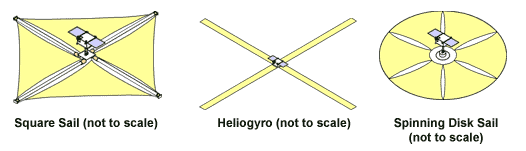
Finding out about solar sails was great fun. I loved the research, and, as soon as I’d read that the circular ones were the most efficient (but no one had figured out how to deploy them), I became convinced we needed a circular one. But how to deploy? Now, in the world of solar sails, you either spin it (circular or heliogyro) or you build a frame. So, what I thought would be best is to fold it up like an umbrella - not wrapped around a pole, but flat along radians. Then, the flat side is rolled around a kick motor (required to bump it up beyond low earth orbit and the residual atmosphere) before unfurling. But the unfurling was my brainstorm: put a rim of flexible material around the surface and inflate it.
But control of a spinning sail is not without its headaches and you need a way of controlling attitude (heliogyro ones change the pitch of the particular blades–JPL’s proposed rendezvous craft was planned as a bladed solar sail). So, since I was in charge of materials, I found a polymer that would harden when exposed to radiation (already being used for space applications). The advantage to using this was that, if the inflating gas leaked away after inflation, it wouldn’t matter after six hours. Additionally, since this provided a lightweight frame as well as a way of deploying the sail, we didn’t have to spin it. The control guy took off with that and we used the payload on four guy wires attached to the rim to control it by changing the center of gravity. I designed the sail out of 2 mil (50.8 micrometer) thick mylar with a 0.2 mil (5.08 micrometer) layer of aluminum. Kevlar cable (their thinnest filament) was used as ripstop along with the glue applied concentrically and along the radial seams. Rip-stopping was vital because Mylar tears like nothing when punctured and micrometeoroids (and, though I didn’t know it at the time, orbital debris) was a serious concern.

Our payload guy was going to wrap the payload in gold foil and we were going to call the beauty “The Heart of Gold” which was both fun and cool (and if you don’t know why, you need to read Hitchhiker’s Guide to the Galaxy). Another of the graduating team members (and, interestingly enough, the only other female) did the navigation and she and I completed extensive write ups before we graduated (out of necessity). I provided our leader with some 34 pages of tightly written text, well within the confines of the requirements and our navigator wrote in detail, very clearly with excellent graphics. And we didn’t see it again until after it had been submitted.

We didn’t win.

We shouldn’t have.

I don’t know if we had the best concept, but, if we had, we still didn’t deserve the prize. After our graduation, our “leader” changed the name to “The Golden Hind” for reasons I never understood or agreed with. Most of my text had been axed and what was left no longer made sense. He had “simplified” much of it so that it was not only unclear but, in many places, um, wrong. The navigation graphics were replaced with a cartoon that, literally, showed the Earth at the center of the solar system. *Sigh*

To this day, there are few things I hate professionally more than leaving a project (still with my name on it) halfway. It happens, but I hate it. But it’s never been as bad as that in all the years since, so at least that’s something.

Cool stuff. Gotta love space.

Read more...

RS Classic: What Do You Know About Tin Whiskers?

>> Friday, July 2, 2010


I have a specific reason for redoing this one right now. I'll repost this because it's (I think) a good intro into the subject and carry forward over the next days as I see fit.

On today’s menu is another real something that has tremendous potential in the plot of a book (particularly science fiction, though any contemporary book could use it): tin whiskers.

Never heard of them, you say? Well, get some popcorn and sit back. Tin whiskers are cool, they’re scary, and we might be hearing much more about these before you know it. See, two years ago, I had never heard of them either. Last year [2007], I wrote a paper on them (You can also find the presentation). The subject is fascinating.

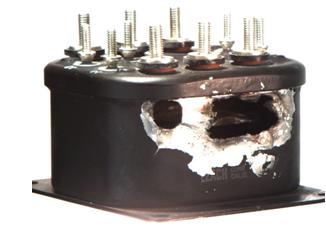
See, certain metals and alloys, particularly when used as a plating, will start to grow slim little hairs of metal. One of them is tin. Most never get more than a few mm long, but others have grown cm long under the right circumstances. Here’s a great picture of some we found in avionics boxes used to control reaction jets and aerosurfaces on the Orbiter (see page 5 of the presentation linked). If they bridge a gap with some power, but not too much, they just fuse and evaporate. If it’s a data connection, they can change a control, turn something on that shouldn’t be, for instance. But, if it has power and the conditions are right, you can get something call metal vapor arcing that will make a big unholy mess. I have some pictures in my linked presentation and paper, but there are other examples at the source for all things metal whiskery: Goddard’s Tin Whisker Website (where you can find the paper and presentation I wrote here and here). For the science minded, this is a treasure trove of data, stories, pictures, videos, pointers, etc. of all kinds of metal whiskers, well worth wandering through. All photos here link to the Goddard website.

Tin whiskers are not a new phenomena. We discovered them the hard way in the 50’s. However, it was discovered early that adding as little as 3% lead to the mix mitigated the whisker problem. But, tin plating is quick, simple, cheap, environmentally friendly and there’s no lead waste to worry over, so tin plated components began working their way into critical circuits. Tin whiskers have been blamed for losing several satellites and the redundant string for others, tripping a nuclear reactor, issues and a major recall on pacemakers, and several ugly accidents with metal vapor arcing. Really, check out those anecdotes.

Tin isn’t the only metal. Zinc and cadmium are also prone to whiskering. Zinc whiskering is becoming a serious concern in computer server facilities. Zinc whisker grows from the galvanized metal shielding on the underside of floor tiles in these facilities. When they go to upgrade or do work below, the floor tiles are lifted up and often shoved over the other floor tiles, shearing the unseen whiskers off and letting them drop into the crawlspace below. When they restart the system, the ventilation, which often flows underneath the floor, picks these whiskers up and sends them right into the computers. Huge, highly redundant server systems have been disabled this way. Really, read about it here or you can just stumble over many resources at the Goddard Tin Whisker Website. They’ve even found lead whiskers, gold whiskers and silver whiskers (though the latter is a different mechanism that grows silver whiskers like mad in a suphur rich environment. See this).

No one’s entirely sure what causes metal whiskers or what factors slow or speed the process. Whiskers may not grow for years and then grow very fast. Others might grow quickly from the beginning.

OK, so this is all cool in a geeky kind of way. So, how is this useful for fiction? Well, whiskers are an effective way to screw up all kinds of redundancy, which is frequently used to mitigate risk for space craft, with one mechanism. It’s one reason why NASA has severe restrictions on the use of pure tin plating. But, it’s not necessarily on the minds of regular people either, so this may not even be on the radar for commercial electronics. That makes it a potential factor in electric cars or planes or, in fact, anything that has critical functions that is governed by electronics. And remember, though we may come up with some way of beating them this time, a generation from now, we might forget about them all over again and have to learn it all over.

Read more...

RS Classic: Space Shuttle Primer

>> Monday, May 31, 2010

As I recover from my son's near death and try to kick start my creative brain, I'm more and more tempted to post some other classics here. So, I will unless I find I have something new and at least remotely clever to say. Though, if I do, it would probably be best if I put it in the novel currently lying fallow.

Baron Rochester asked me about Shuttle reusability. I gave him a quick answer, but, really, I think his question deserves a more complete answer because the Shuttle is a rather unique vehicle.

As the Apollo program came to an end (and you don’t want to ask me how I feel about that), much of the space focus turned to the highly lucrative but very expensive world of satellites. Up until then (and in fact, continuing on today), most space craft were launched into space using staged expendable rockets. From the beginning, an orbiting space station built with help from the Shuttle was part of the vision, but the US was also very interested in finding a more cost effective method for getting satellites into space and even bringing them back down. Additionally, they hoped to use the Shuttle as an orbiting laboratory for larger scale experiments than ever possible before. It cannot be stressed enough that, with the possible exception of being “cost effective,” the Space Shuttle system has achieved all of these far reaching goals.

The Space Shuttle is a complex system. It includes the reusable Orbiter, the refurbishable Solid Rocket Motors, and the expendable External Tank which supplies the fuel (cryogenic oxygen and hydrogen) for the Orbiter’s main engines. The Orbiter’s main engines are among the most efficient chemical engines ever.

There were a total of seven Orbiters built. The first one, Enterprise, was used for testing but never flew in space (sorry, Roddenberry).The other five were put into use as they were completed: Columbia, Challenger, Discovery, Atlantis and, after Challenger was lost, Endeavour. We are down to three now, Discovery, Atlantis and Endeavour.

Of course, I could talk more about the Orbiter, about their lightweight, but delicate thermal tiles and surfaces, some capable of withstanding nearly 3000 deg F (1650 Deg C), which are engineering marvels all their own, despite their vulnerabilities. But Kathleen asked a good question and I have to get to that.

Even so, I have to mention the two Orbiters we lost, with their full complements. The first, on January 28, 1986, was the Challenger accident when the Shuttle broke up 73 seconds into the launch due to a leak/burnthrough of the Solid Rocket Motor. We lost seven astronauts on that flight: Michael J. Smith, Dick Scobee, Ronald McNair, Ellison Onizuka, Christa McAuliffe (a teacher), Gregory Jarvis, Judith Resnik. I wasn’t here for that. I was a freshman in college and it’s still hard to believe that it happened more than 20 years ago.

Then, there was the loss of STS-107, Columbia, the oldest of our Orbiters during reentry. I was here for that one. In fact, it was my flight (EVA Safety Lead). Columbia was destroyed when damage to her wing leading edge lead to burnthrough and eventual destruction of Columbia on her way in. I knew this crew personally and I still can’t think of it without tears coming to my eyes. Those lost were David Brown, Laurel Clark, Michael Anderson, Ilan Ramon, Rick Husband, Kalpana Chawla, William McCool, another seven.

Read more...

Labels

Blog Makeover by LadyJava Creations