Showing posts with label engineering. Show all posts

Engineering and Women

>> Saturday, November 23, 2013

So, someone I know on facebook posted a link to an ad by GoldieBlox, touting the notion that girls don't have to be stuck with "girl toys" that don't do anything and doom them to particular life roles/preclude them from certain professions. It's a cute ad, but I'm afraid I feel they still don't get the concept.

Here's a quote from their "about" page: "By tapping into girls' strong verbal skills, our story + construction set bolsters confidence in spatial skills while giving young inventors the tools they need to build and create amazing things." So, by tapping into a stereotypical quality girls are supposed to have, you think you can help them overcome a stereotypical deficiency.

But stereotypes are the problem. Oh, not the whole problem. It is certainly possible, even probable that, overall, more girls are genetically predisposed to verbal skills over spatial reckoning, etc.  So what? First of all, since neither motor skills or spatial reckoning is my strength, I can say that the lack thereof hardly precludes becoming an engineer, excelling at math, excelling at physics, and making a career in that field, because, hey, I did it.

More importantly, what is "generally" true doesn't mean diddly to an individual. There are any number of dead-eye female pilots who have spatial reckoning (and generally other aspects of science and or engineering like Eileen Collins, the first female Space Shuttle commander) or engineering intuition, or math skills out the wazoo. Each girl, like every boy out there, is an individual, who might be dead on the money on some stereotypical feature and blowing the curve on the next.

The problem isn't the toys. It's what you hear and what you see and what you're shown growing up. It's the level and tenor of the expectations your parents and teachers and mentors and even peers have that discourage girls from pursuing engineering and science and math. If you don't change that, nothing changes.

Because, here's the thing. If you find "girl" toys too limiting for your little princess, there isn't a thing in the world that keeps you from getting her building blocks (they come in pink, too)  or robots or tinkertoys or trains or remote control cars or science kits. Getting her those things won't stop her from being your princess any more than Barbies and babydolls and Hello Kitty stuff will make her a princess if that's not what she wants to be. Not only can you do it now, you could ALWAYS do it.

I'm a parent. I buy the things my kids show an interest in. My son likes wooden puzzles and Legos and cars and blankets. He likes stuffed animals, too, but his sister steals them (he steals her blankets so it's all good). His sister loves dolls and tea sets and cars and figurines of any kind and stuffed animals. I've bought her puzzles, but she's not interested in them though she completely conquered a set of latches in seconds. They both inherited 9000 books and I keep buying them more though neither will let me read to them.

I will continue to buy my children things they show an interest in, not worried about gender or stigmas because, in this house, there's no stigma if my son plays with a doll or wants to get his toenails painted (he does, if I'm painting nails). There's no stigma if my daughter plays with cars or Legos - why would there be? And that is how I'll raise my children, how I raised my eldest daughter. I will tell them, and absolutely believe it and show it in word and deed, that nothing is automatically beyond them, that the only limits on them are in their talent and the limits they set themselves.

I won't make a big deal out of it because I don't have to. I just have to keep from getting in their way. No one had to tell me I could do complex math as well or better than anyone else because it never occurred to me that I couldn't. No one had ever told me I couldn't so why would I think so? No one had ever imposed any restrictions on my abilities or told me I had no business learning X subject or Y subject so I grew up figuring out what I was good at and wasn't good at by myself, through exposure. I never had teacher say, "I don't think a girl like you belongs in physics" any more than I had a parent who said, "Girls should stick to home ec or typing." Actually, I think my mother wanted me to take both subjects, but I stunk at them. But no one stopped me from taking science or math or engineering or anything else I wanted. I do know women, many of them engineers now, who DID have that happen, with parents or college professors or boyfriends, etc.

I was able to find my own limits because no one imposed their own limits, or their perceptions of my limits, on me. And that, boys and girls, is the key, I think. You can't make a boy good at math because he's supposed to be any more than making him play football and learn kung fu will keep him from being a drag queen if that's what he's got a hankering to do (as many a homophobic parent has discovered). People set their own limits and gravitate to the things they excel at or enjoy. If you haven't set any limits, they may still aim small. Or a direction you never saw. But there's nothing wrong with wanting to be a kindergarten teacher or a nurse or an oral hygienist. Nothing wrong with being a drag queen either if it makes you and others happy.

It's when we set preconceived limits upon our children that we limit their potential. If we tell our girls over and over that girls just can't do math, chances are, when they take algebra, they'll be convinced it's beyond them, whether it really was or not. If we tell our children that they can't ever go to college because they're too poor and will have no choice but to work, those children might very well never even try for opportunities intended for kids just like them because they've decided it's hopeless. If we treat children who are Latino (and may struggle with English especially at first) or black as if one couldn't expect much from them, they will likely fulfill our expectations, even if those expectations are unvoiced.

There are many who believe children from the far east are inherently smarter. I don't think so. Their culture values education and parents routinely make sacrifices and have huge (perhaps too huge) expectations of their children. That has its own issues but instilling unnecessary limitations isn't one of them (though there is notably a difference, even now, in what's expected from boys and girls in those cultures). I think this difference in emphasis and expectations is the key to their relative success.

You want your child to fulfill their potential? Buy them toys and games and books and encourage activities that excite, interest, and challenge them. Not you, not other people's children, but them, your children, the individuals. Their imagination might take off with building sets or action sets. It might be dolls and doll houses. It might be puzzles and physical toys. Talk to them, get to know them, encourage their interests and strengths. Find what each individual child responds well to and what encourages those children in subjects or fields that might have not interested them before.

But, whatever you do, don't get in their way. Don't ever let your own limitations or perceptions of their limitation get in the way of their succeeding where you never expected it. Kids can do that, more often than you think.

If we'd just let them.

At least, that's how I see it.

Read more...

RS Classic: What Do You Know About Tin Whiskers?

>> Friday, July 2, 2010


I have a specific reason for redoing this one right now. I'll repost this because it's (I think) a good intro into the subject and carry forward over the next days as I see fit.

On today’s menu is another real something that has tremendous potential in the plot of a book (particularly science fiction, though any contemporary book could use it): tin whiskers.

Never heard of them, you say? Well, get some popcorn and sit back. Tin whiskers are cool, they’re scary, and we might be hearing much more about these before you know it. See, two years ago, I had never heard of them either. Last year [2007], I wrote a paper on them (You can also find the presentation). The subject is fascinating.

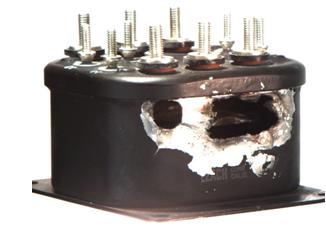
See, certain metals and alloys, particularly when used as a plating, will start to grow slim little hairs of metal. One of them is tin. Most never get more than a few mm long, but others have grown cm long under the right circumstances. Here’s a great picture of some we found in avionics boxes used to control reaction jets and aerosurfaces on the Orbiter (see page 5 of the presentation linked). If they bridge a gap with some power, but not too much, they just fuse and evaporate. If it’s a data connection, they can change a control, turn something on that shouldn’t be, for instance. But, if it has power and the conditions are right, you can get something call metal vapor arcing that will make a big unholy mess. I have some pictures in my linked presentation and paper, but there are other examples at the source for all things metal whiskery: Goddard’s Tin Whisker Website (where you can find the paper and presentation I wrote here and here). For the science minded, this is a treasure trove of data, stories, pictures, videos, pointers, etc. of all kinds of metal whiskers, well worth wandering through. All photos here link to the Goddard website.

Tin whiskers are not a new phenomena. We discovered them the hard way in the 50’s. However, it was discovered early that adding as little as 3% lead to the mix mitigated the whisker problem. But, tin plating is quick, simple, cheap, environmentally friendly and there’s no lead waste to worry over, so tin plated components began working their way into critical circuits. Tin whiskers have been blamed for losing several satellites and the redundant string for others, tripping a nuclear reactor, issues and a major recall on pacemakers, and several ugly accidents with metal vapor arcing. Really, check out those anecdotes.

Tin isn’t the only metal. Zinc and cadmium are also prone to whiskering. Zinc whiskering is becoming a serious concern in computer server facilities. Zinc whisker grows from the galvanized metal shielding on the underside of floor tiles in these facilities. When they go to upgrade or do work below, the floor tiles are lifted up and often shoved over the other floor tiles, shearing the unseen whiskers off and letting them drop into the crawlspace below. When they restart the system, the ventilation, which often flows underneath the floor, picks these whiskers up and sends them right into the computers. Huge, highly redundant server systems have been disabled this way. Really, read about it here or you can just stumble over many resources at the Goddard Tin Whisker Website. They’ve even found lead whiskers, gold whiskers and silver whiskers (though the latter is a different mechanism that grows silver whiskers like mad in a suphur rich environment. See this).

No one’s entirely sure what causes metal whiskers or what factors slow or speed the process. Whiskers may not grow for years and then grow very fast. Others might grow quickly from the beginning.

OK, so this is all cool in a geeky kind of way. So, how is this useful for fiction? Well, whiskers are an effective way to screw up all kinds of redundancy, which is frequently used to mitigate risk for space craft, with one mechanism. It’s one reason why NASA has severe restrictions on the use of pure tin plating. But, it’s not necessarily on the minds of regular people either, so this may not even be on the radar for commercial electronics. That makes it a potential factor in electric cars or planes or, in fact, anything that has critical functions that is governed by electronics. And remember, though we may come up with some way of beating them this time, a generation from now, we might forget about them all over again and have to learn it all over.

Read more...

Penny Wise, Pound Foolish

>> Wednesday, June 30, 2010


Dell's woes are in the news, how they had potentially millions of business/education computers with faulty motherboards.

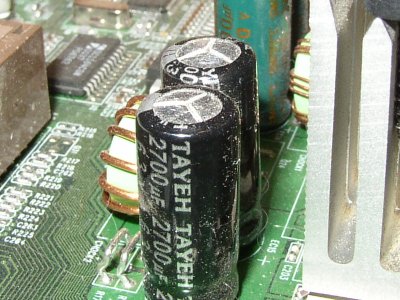
There's quite a story there. Apparently, there was a family of electrolytic aluminum capacitors manufactured in Taiwan that became very popular even though they were only a fraction less expensive than the Japanese parts. Millions were used only to find that they were counterfeit, using an flawed formula that caused failure, often within six months.

Dell, of course, was not the only victim of these counterfeit parts. Many were duped (estimated cost of this specific set of faulty capacitors was estimated at $100 million (though I'm not sure that tally's done). Many no doubt had to replace equipment as a result. Dell's reaction stands out because of the denial of problems and replacing defective parts with more defective parts. You know, sharing the pain.

But the part that gets me is that the thinking that allows a counterfeit part to get into critical equipment, the thinking that saving a penny today without understanding the repercussions is fine. It's behind the BP fiasco. It's behind many so many companies being taken in by counterfeiters, too. They don't take the trouble - after all, many times, the consumer will be the one to suffer if the parts fail earlier than intended with minimal repercussions on their own.

But, as BP and Dell both know now, that thinking can backfire, rather dramatically.

We need to be thinking of this kind of thing as we make decisions today. I understand how tempting it can be to save a penny here and there today and figure that will do. But, in the long run, doing it right the first time always costs less than redoing it, particularly after it's been put into use, put into space, put in a critical component.

Often much much more.

Read more...

What you Don't Know You Don't Know

>> Monday, June 21, 2010


Read an interesting article today in the NYT (which I like reading, so there) which was discussing people ignorant of their ignorance.

Now before you start scratching your head wondering what I'm talking about, let me explain. Everyone has areas of expertise and incompetence, things they know well and things they don't know. Nothing wrong with that.

For instance, someone might not know all six wives of Henry VIII or why the fact he divorced his first was important. They don't know, but most might know they didn't know. However, there are others who won't have any idea who Henry VIII is or that he had several wives or that his need to throw his first wife over is a big factor in why that so many in North America are protestant. Unless you ask him, he doesn't realize he doesn't know nor likely care why you might think it's important.

There's nothing wrong with that. I know I don't know the proper formula for brick mortar. I also know that, if I decided to build a house by myself, I would have to learn a great deal I don't know (known unknowns) but there are likely dozens of other things I wouldn't even know I didn't know that could ruin what I was trying to do (unknown unknowns) and that I'd be foolish to attempt it without expert help.

The article was focused on these people who don't realize that there's so much they don't know. In the article, they were focused on incompetence/ignorance, people who were clueless about their cluelessness. And we all know folks like that. These are Darwin award winners and crooks too stupid to be believed. And talk show commentators. And, apparently, senators, or at least some of them.

But I don't want to talk about them. There are tons of posts and stories and articles about the chronically clueless. What I want to talk about is the fact that all of us - all of us - have some of these aspects, too, those areas where were are not only ignorant, but that we can't even objectively quantify our ignorance or the implications of our ignorance.

That's one of the things that drives me crazy in the space industry. Too many people think we've figured out all the unknowns, so we can cut our conservatism and safety margins to the bone. I say "nay nay," because I know those margins, those excesses, those versatilities are what kept Apollo 13 from being a tragedy and has saved our spacebuns many a time. Because there are accidents and failings you never even thought of, environments you never considered, aspects you just didn't see coming. (Though it's even more frustrating when people refuse to even address the problems you can readily see - but that's another story).

But it's not just true of space exploration. It's true of engineering and science, of course, but it's true of every day aspects of life. Unexpected illnesses or accidents happen. Jobs are lost. Things you didn't know you didn't know can bite you in the butt.

If we're smart, we not only acknowledge what we don't know, we look for experts where we can and prepare for the worst when there's no one that knows.

Read more...

Labels

Blog Makeover by LadyJava Creations